How much does a Fire Risk Appraisal of External Walls (FRAEW) cost? It is usually the first question a responsible person or managing agent asks, and the honest answer is that it depends — but it depends on a short, knowable list of factors, not on mystery. Anyone quoting a price without asking about those factors is guessing, and anyone paying that price is buying a guess.
This guide explains what a FRAEW under PAS 9980:2022 (the British Standards Institution's publicly available specification for external wall appraisal) actually involves, what genuinely drives the fee, what a fair quote should itemise, and the questions worth asking before instructing anyone. It is written for the person paying the invoice, not for other fire engineers.
What you are actually paying for
A FRAEW is not a form-filling exercise. Under PAS 9980, a competent assessor reviews the construction records — original design documents, building regulations information, warranties, any previous investigation — then carries out a desktop risk assessment to establish what is known about the wall build-up and where the unknowns sit. The building is then inspected: accessible elevations surveyed, and, where the records cannot establish what is actually in the wall, intrusive opening-up carried out to expose the construction and settle the question.
The output is a reasoned risk rating for the wall as a system — materials, cavity barriers, fixings, combustible attachments and their relationship to the means of escape — with the evidence and reasoning set out in full. The fee, in other words, buys two things: investigation effort and professional judgment. Both scale with the building, which is why no two appraisals should cost the same by default.
The things that genuinely move the fee
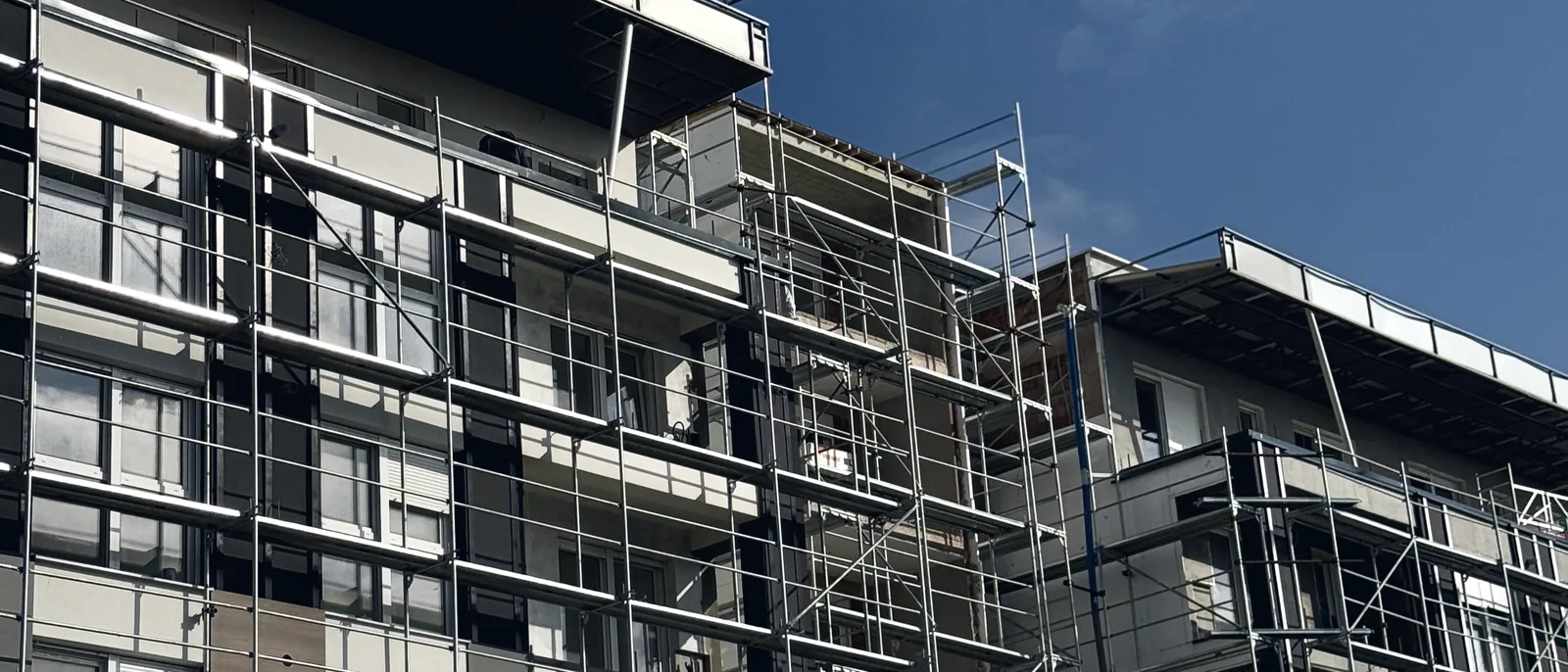
Building height and size come first. A taller building has more elevation area to survey, more wall to account for, and usually a harder access problem — scaffold, a mobile elevating work platform or rope access where a ladder survey will not do. Access arrangements can be a material slice of the overall cost on tall or awkward buildings.
Elevational complexity matters as much as sheer size. A building with one wall system repeated on four elevations is a much smaller appraisal than a building of the same size with several distinct systems — brick here, render there, a rainscreen zone, balconies and other attachments — because each system has to be established and assessed in its own right.
Then the quality of the records. Where the construction is well documented, the desktop stage does much of the work and the inspection confirms it. Where records are missing, incomplete or untrustworthy — common in older or much-altered buildings — the assessor must establish the baseline from the building itself, which means more inspection time and more opening-up. Each intrusive opening carries survey time, making good, and coordination with residents and management.
Finally, portfolio scale works in the client's favour: appraising several blocks under one instruction spreads the fixed costs of mobilisation and desktop review, and reduces the unit cost per building.
How to get a real number for your building
Because every one of those drivers is specific to the building, an honest fee is too — which is why we do not publish a rate card, and why you should be wary of anyone who does. A credible assessor scopes first: the records available, the elevations and how they will be accessed, the number of sample openings agreed up front — and then commits to a fixed fee. A fee produced without that scoping conversation is either padded to cover the unknown or too thin to do the work properly.
Treat any quote that lands before these questions have been asked with caution. The scoping conversation costs you nothing, takes little time, and is itself a useful test of the assessor: the questions they ask about your building tell you how they will treat it.
Why the cheapest appraisal is often the most expensive
PAS 9980 exists to make proportionate judgments possible: some walls are acceptable as they stand, some warrant targeted work, some need interim measures while a programme is developed. Reaching the proportionate answer takes evidence — and evidence takes investigation time. An appraisal priced too low to do that investigation cannot reach a confident conclusion, and an assessor who cannot be confident must be conservative: assume the worst about what the records did not show, and recommend accordingly.
That is how a cheap appraisal becomes the most expensive document a building ever commissions. An over-conservative conclusion can trigger remediation the building never needed, at a cost that dwarfs the difference between a thin appraisal and a thorough one — or it triggers a second, proper appraisal to unwind the first. Paying for enough investigation to support a proportionate conclusion is almost always the cheaper path.
Independence bears on this too. An assessor who also sells remediation has a structural interest in what the building turns out to need. Apex carries no installation or remediation arm, so the conclusion — including the conclusion that a wall is acceptable as it stands — reflects the evidence and nothing else.
The EWS1 question
Many FRAEWs are commissioned because a lender has asked for an EWS1 (External Wall System) form. The two should be priced and understood together: the EWS1 is a one-page declaration of a conclusion, and the FRAEW is the appraisal that makes the conclusion defensible. An assessor who has completed the FRAEW can complete the form on the back of it — the form is the output, not a separate product. Our comparison of EWS1 and PAS 9980 covers the distinction in full; for cost purposes the point is simple: budget for the appraisal, and confirm whether completion of the EWS1 form is included in the fee or charged separately.
What a quote should itemise — and what to ask
A fair FRAEW quote should itemise: the scope of the desktop review; the elevations to be surveyed and how they will be accessed; the number and indicative locations of sample openings, and who makes good afterwards; the deliverable — a risk-rated report with reasoning, not a bare rating; whether EWS1 completion is included; and what would trigger a variation, so a surprise behind the cladding does not become a surprise on the invoice.
Before instructing, ask four questions. Who will carry out the appraisal, and what is their competence and registration for this work? Does the firm hold any interest in remediation or installation? What happens to scope and fee if opening-up finds something unexpected? And what can the report be used for beyond the immediate need — a fire risk assessment that flagged the wall, a building safety case, a lender? A report written properly serves all of them; a report written only to get a form signed serves none for long.
If you want a real number rather than a range, send us the building: address, height, what you hold by way of records, and what prompted the question. We will scope the appraisal and return a fixed fee — and if the building does not need a FRAEW at all, we will say that instead.
Common questions
What does a FRAEW quote typically include?
A properly scoped quote covers the desktop review of construction records, a desktop risk assessment, survey of the agreed elevations including access arrangements, an agreed number of intrusive sample openings with making good, and a PAS 9980 report with a risk rating and full reasoning. Ask whether completion of an EWS1 form is included in the fee or charged separately — practice varies between firms, and it is better established before instruction than after.
Does every building need a FRAEW?
No — and confirming that a building is out of scope is the cheapest outcome of all. PAS 9980 applies where the external wall construction is a material consideration for fire risk; for conventional masonry buildings with nothing combustible attached, a competent fire risk assessment can usually settle the question without a full appraisal being commissioned. Our comparison of EWS1 and PAS 9980 sets out the scope test in more detail.
Why do FRAEW quotes for the same building differ so much?
Usually because the quotes assume different amounts of investigation. One assessor may be pricing a records review and a visual survey; another may be pricing the opening-up needed to actually establish the wall build-up. The thinner scope looks cheaper but is more likely to end in an inconclusive or over-conservative report. Compare quotes on scope — elevations, openings, access, deliverable — before comparing them on price.
Is the cheapest quote a false economy?
Often, yes. An appraisal without enough investigation behind it forces a conservative conclusion, and a conservative conclusion can mean remediation the building never needed or a second appraisal to establish what the first one should have. The fee difference between a thin appraisal and a thorough one is small against the cost of either outcome.