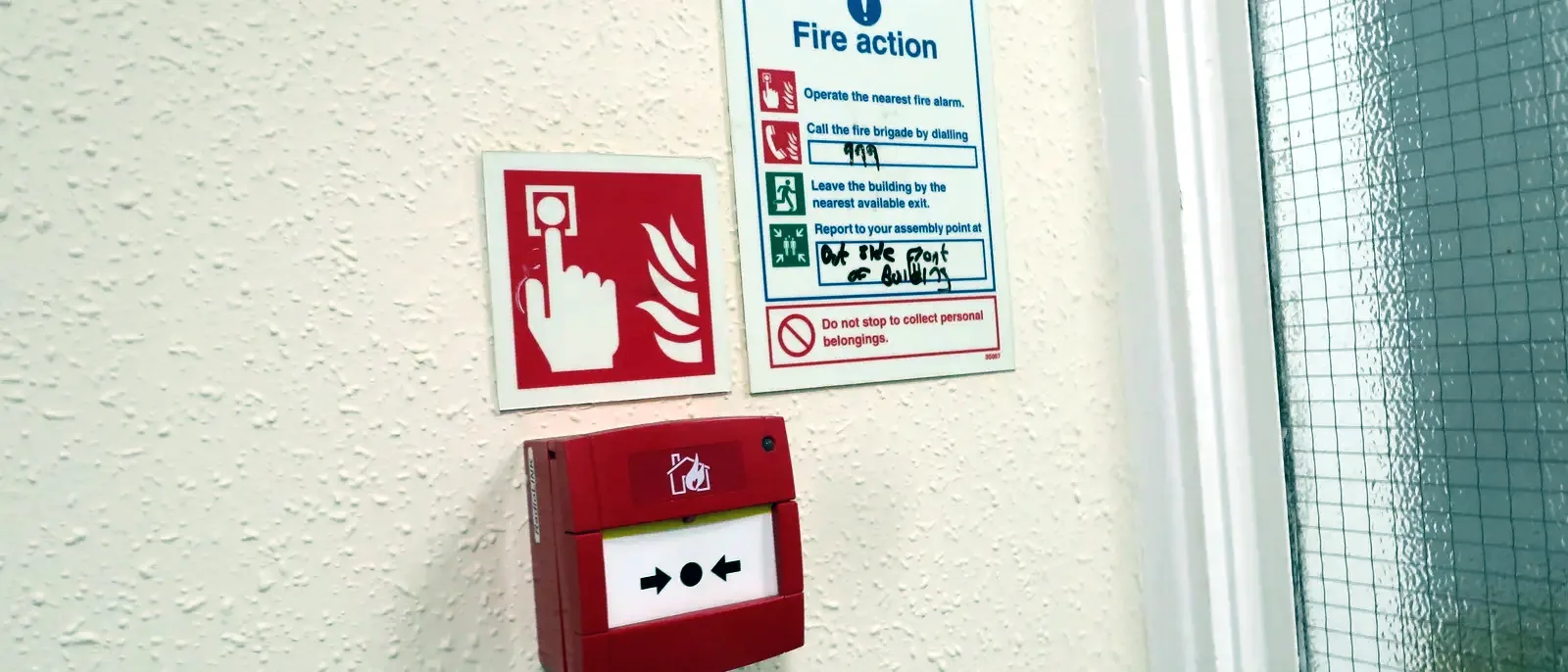
The Regulatory Reform (Fire Safety) Order 2005 (RRFSO) is the primary piece of fire safety law for England and Wales. It applies to virtually every non-domestic premises and to the common parts of every multi-occupied residential building, and it works differently from most safety legislation: rather than prescribing a fixed set of measures for every kind of building, it puts the duty to identify and manage fire risk onto a single named role — the "responsible person" — and requires them to reach a judgement about what their own premises actually need.
That structure has advantages and a real cost. It means the Order can flex from a small shop to a thirty-storey residential tower without rewriting the rulebook for each one. It also means there is no checklist a responsible person can work through and call the job done — the duty is to assess the risk, act on it, and keep both current.
Who is the responsible person?
Article 3 of the Order defines the responsible person in two parts. For a workplace, it is the employer, if the workplace is to any extent under their control. For any other premises — including the common parts of a block of flats — it is the person who has control of the premises in connection with a trade, business or other undertaking, or, where the person in control has no such connection, the owner. In practice this usually means a freeholder, a right-to-manage company, a residents' management company, or a managing agent instructed to act on their behalf.
A single building can have more than one responsible person at once — a landlord for the common parts, and separate business tenants each responsible for their own demise, for example. Where that happens, Article 22 does not leave the overlap to chance: each responsible person must co-operate with the others so far as necessary to comply with the Order, take reasonable steps to co-ordinate their respective fire safety measures, and tell each other about any risks their own activities create. A managing agent who has never spoken to the ground-floor tenant's safety contact is not meeting that duty, whatever the paperwork says.
The core duties the Order imposes
Article 4 defines "general fire precautions" as the measures a responsible person must consider: reducing the risk of fire and of fire spreading, means of escape, keeping the means of escape safely and effectively usable at all material times, means for detecting fire and giving warning, means of fighting fire, and — for employees specifically — arrangements for the action to be taken in the event of fire, including instruction and training. Article 8 then imposes the central duty, in two limbs: for employees, such general fire precautions as will ensure their safety so far as is reasonably practicable; and for relevant persons who are not employees — residents, visitors, anyone else lawfully on or near the premises — such general fire precautions as may reasonably be required in the circumstances of the case to ensure the premises are safe.
That duty starts with Article 9: a suitable and sufficient assessment of the risks to which people on the premises are exposed, carried out to identify the general fire precautions actually needed. The assessment must be reviewed when there is reason to think it is no longer valid, and the findings must be recorded in writing in every case — including the measures already taken or planned, and any group of people identified as being especially at risk. The old thresholds that once limited the recording duty (five or more employees, a licensed premises, an alterations notice) were removed by section 156 of the Building Safety Act 2022, with effect from 1 October 2023. Article 10 requires that assessment to translate into preventive and protective measures, applied where necessary against the standard principles of prevention set out in the Order.
The remaining duties build out from there. Article 11 requires fire safety arrangements — the planning, organisation, control, monitoring and review of those measures — proportionate to the size of the undertaking, and again recorded in writing in every case. Article 13 covers fire-fighting equipment and detection; Article 14 covers emergency routes and exits, kept clear and leading as directly as possible to a place of safety; Article 15 covers procedures for serious and imminent danger, including drills and nominating competent people to help with evacuation; and Article 17 requires the premises and any fire safety equipment provided to be maintained in efficient working order. Article 18 lets the responsible person appoint a competent person to help meet these duties — appointing help does not transfer the underlying responsibility. Articles 19 and 21 add duties to inform and train staff; Article 23 places a reciprocal duty on employees to use what they are given properly and to report anything they see as a serious and immediate danger.
Where the Order sits alongside newer regimes
The RRFSO has not stood still. The Fire Safety Act 2021 put beyond doubt that, for buildings with two or more sets of domestic premises, the duty extends to the building's structure and external walls — including cladding, balconies and windows — and to flat entrance doors, not just the common parts in the traditional sense. The Fire Safety (England) Regulations 2022 (SI 2022/547) then added specific, more prescriptive duties on top for higher-risk residential buildings, covering matters such as fire door checks and information for residents and the fire and rescue service.
For the tallest, highest-risk residential buildings, the Building Safety Act 2022 layers on a further regime — accountable persons, safety cases and registration with the Building Safety Regulator — but it supplements the RRFSO rather than replacing it. A principal accountable person is very often also the responsible person under the RRFSO for the same building, and the general fire precautions duty does not disappear because a more specific regime now also applies.
Common misconceptions
The most common misconception is that a fire risk assessment is a one-off document, filed once and left alone. Article 9 requires it to be reviewed whenever there is reason to suspect it is no longer valid — a change of use, an alteration to the building, a near-miss, or simply the passage of enough time that the original assessment can no longer be relied on. A five-year-old assessment for a building that has been reconfigured twice since is not doing its job, whatever date is printed on the cover.
A second misconception is that only large organisations need to write anything down — a five-or-more-employees threshold many responsible persons still quote. It was real once, but section 156 of the Building Safety Act 2022 removed it: since 1 October 2023 the findings of every fire risk assessment, and the fire safety arrangements, must be recorded in writing regardless of headcount, licensing or notices. The record also matters beyond bare compliance: a responsible person who cannot produce evidence of what was assessed, when, and what was done about it is in a weak position if the assessment is ever challenged. A third misconception, more relevant to residential blocks, is that whoever carries out the assessment needs no independence from what it recommends. Article 18 lets a responsible person appoint help precisely because they are not expected to be a fire engineer themselves — but the value of that appointment depends on the assessor having no stake in whatever remedial work the assessment turns up.
What to do now
For anyone managing a building, the practical starting point is straightforward: confirm who the responsible person actually is for each part of the building — there may be more than one — and check that a current, suitable and sufficient fire risk assessment exists and reflects the building as it is today, not as it was when last written. Where arrangements should be recorded in writing, check that they are, and that maintenance and training records back up the paperwork. Where the building is high-rise or multi-occupied residential, check whether the 2022 Regulations or the Building Safety Act also apply, because meeting the RRFSO alone is no longer the whole picture for those buildings.
Apex carries out fire risk assessments across residential and commercial buildings (Apex holds no installation or remediation arm), assessed and prioritised in proportion to the building rather than against a generic template.
Common questions
Can a building have more than one responsible person?
Yes. Article 3 of the Order defines the responsible person by reference to control of the premises, and a single building can have several — a landlord responsible for the common parts, and separate business tenants each responsible for their own space, for example. Article 22 requires responsible persons sharing a building to co-operate, co-ordinate their fire safety measures, and tell each other about relevant risks.
Does a fire risk assessment always have to be written down?
Yes. Since 1 October 2023, when section 156 of the Building Safety Act 2022 amended the Fire Safety Order, the responsible person must record the findings of the assessment — and the fire safety arrangements — in writing in every case. The old thresholds (five or more employees, a licensed premises, an alterations notice) no longer apply, and a record that cannot evidence what was assessed and what was done leaves the responsible person poorly placed if the assessment is later challenged.
Does the Building Safety Act 2022 replace the Fire Safety Order for high-rise buildings?
No. The Building Safety Act 2022 adds a further regime — accountable persons, safety cases and registration with the Building Safety Regulator — for higher-risk buildings, but it sits alongside the Fire Safety Order rather than replacing it. The general fire precautions duty under the 2005 Order continues to apply.